Thursday, March 16, 2017

A Guided LEGO Play


LEGO is for play and is for everybody. Through LEGO, we discover our creativity, and during the process, we find our pleasure.
In front there are a few pieces of LEGO, our fingers naturally reach out to snap them together producing a gentle but reassuring clicking sound. The pieces are suddenly alive inviting us to turn them around and imagine all the possibilities they can be transformed into.They could be changed to an animal or a fantasy building we have not even seen before. Take a few pieces off and add a few more, and then new possibilities emerge. Our fingers flip through the rest of parts. Sometimes the needed pieces are right there allow the continuing of the building. Other times, they are not available. With the fingers still on the pieces, we do not mind looking around or shouting out to get help. When realized the pieces we need are not available, we can always find some pieces can be repurposed to become a useful building block. Finally, creation is born. Imagination becomes a reality. Joys are not just from us but also from people look at it and touch it. All these can happen in just a few minutes. Because of such fun experiences,  LEGO is widely recognized as an intellectual toy.  Many want more out of it than just playing. They hope to use it as a tool to make people especially kids more creative and help them grow intellectually. This is why people are willing to spend a lot of money on expensive LEGO products.
One common misconception, however, is that just playing with a pile of LEGO will automatically help sustainable creativity.  On the contrary, randomly playing LEGO, while is enjoyable, it does not make LEGO a different from other toys. To make a LEGO as a creativity tool, it needs a guided play.  This is just like to play in a pool will not make people become a swimmer, which requires specialized training and guidance.
I discovered this process of making my own LEGO creations, teaching and exhibiting at various events throughout years including Maker Faire, Bring Your Child to Work Day, Stanford Splash Program, and Workshop Weekend. After giving some guidance and challenges, the kids in my classes or at our booth can create amazing things in a very short period of time.  

Monday, April 25, 2016

Celebrate the DNA day with a PacBio Sequel LEGO model

What an exciting celebration! Since PacBio released the Sequel late last year, I have been thinking about to build a miniature model of it. Besides appreciating the new features and dramatically increased throughput, I also was intrigued by Sequel's design. It has an elegant curved front. It looks nice, but posts a great challenge to LEGO building. It is of cause the fun part for me. I have never built a curved model like it and have not seen one either. After tried a few ideas, I found that the LEGO train track pieces can provide the curvature needed. After nailed the shape challenge with the breakthrough, I was thinking to add a real moving door. To do that, the experiences of coaching a First Lego League (mdfirst.org) team came handy. I used a rack gear to make it happen. It can be seen in the work deck. The door can be operated by a handle in the back of the model. It is fun to play with. Thank you for reading and Happy DNA Day!

Friday, April 20, 2012

1x2 Plate DNA model

To celebrate the DNA, I released a few new DNA models that created by 1x2 plates. The idea is to make it easy for people to build their own DNA models because now it only requires one type of pieces instead of several special pieces before.

Sunday, April 1, 2012

Animal Models made of 1 x 2 plates

I am still fascinated with using the simplest Lego pieces to build structures. Here are some new builds to celebrate my acceptance as a Maker to Maker Faire 2012 (Bay Area) again. I am sure that you can recognize them, but just in case. They are peacock, butterfly, crocodile, giraffe, bird, monkey. The monkey was partially built by my daughter. I really like the tail she made.


Monday, March 19, 2012

MinION Lego

I heard it. Oxford Nanopore will not be released for months. It has promised big and a lot. Many people are anxiously waiting them to release “real” data. Is it really 96% accuracy? No sample prep, no kidding?

Instead of just thinking about it, I chose to do something fun. I released my Lego MinION model at ABRF 2012, a meeting mostly for Omics facility crowd, who are often my hard working colleagues to generate more than enough data for me to analyze.

So far, I can only find three pictures of MinION on the Web. So the model is built based on those snapshots. The model can be totally wrong. But several people recognized it at the meeting without me telling them what it is.

The Lego model should be similar in size as the published pictures. The USB drive in my model is a working one. It can hold one human genome. In addition, my Lego sequencer also do not have length limit of sequencing. The average accuracy is ~25% and sample prep is optional. Another important feature is that the back of the Lego sequencer has a camera. So it can take a picture before it sequences a thing of interest.


Tuesday, March 13, 2012

Dog models of 14 1X2 Lego plates

Recently, I have been thinking a lot about using only 1 X 2 Lego plates to build models. 1 by 2 plate is the smallest unit that has a connection in Lego system. They should be able to build a as complex (or simple) structure as you can imagine. One simple model I built that is enough to impress my children is a dog model. Since 1x2 plates are easily available at home or to buy from Lego stores, I do encourage you to try it.

Tuesday, March 6, 2012

Lego 1X2 Plate Build

To build a complex structure does not necessarily need complex Lego pieces. I has been thinking about to use just 1x2 plates to build models since they are the smallest Lego units that provide connections. Here is a few tries on animal models.


Thursday, March 1, 2012

Make Faire Interview

Here is a video of an interview at Maker Faire 2011 on my DNA models. I was very pleased with the final cuts.

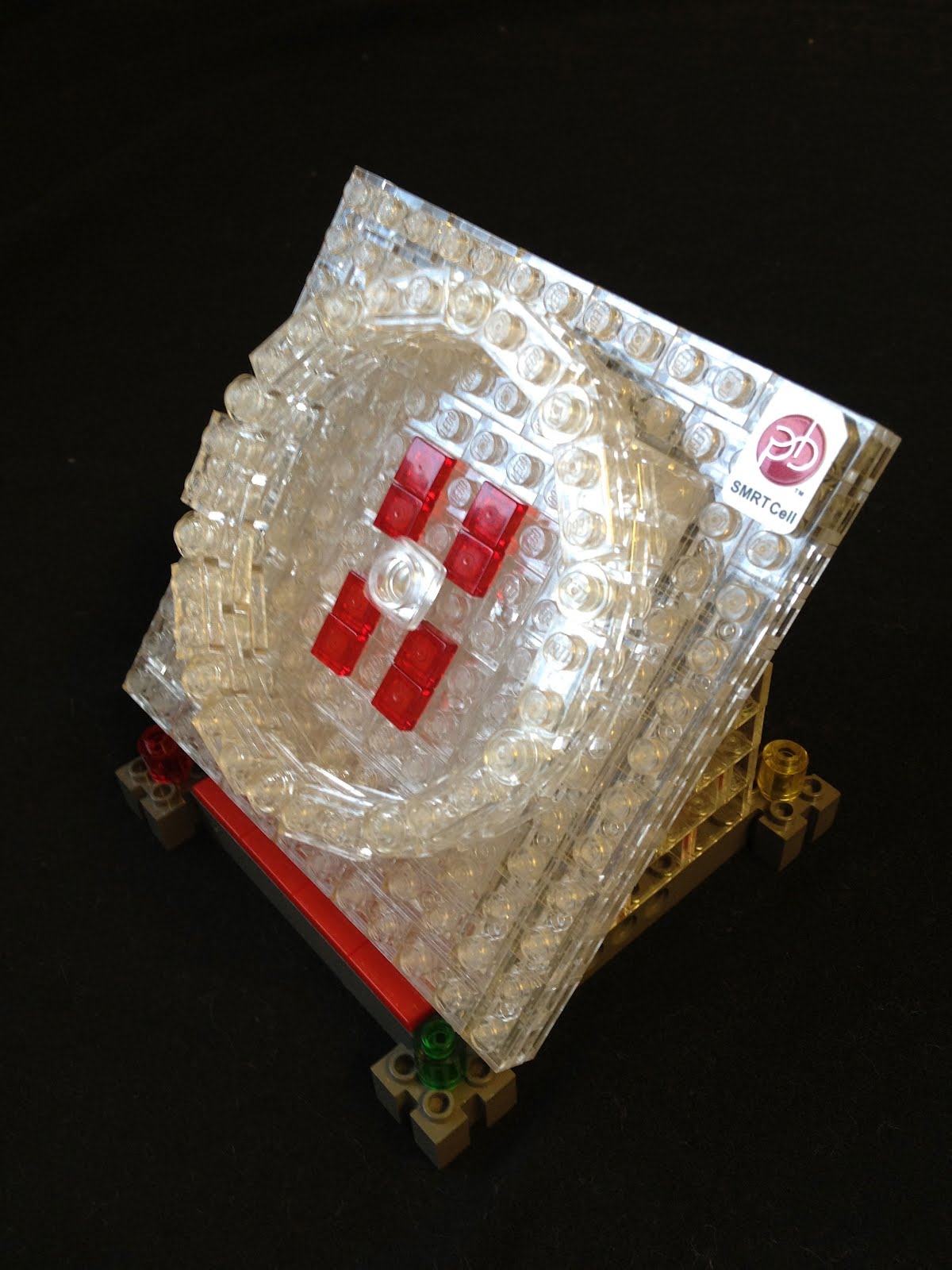
This is my first LEGO model on the third generation sequencing technology. It is a model of SMRTCell of Pacific Biosciences. It was built as a prompt for my wife's party.

The SMRTcell was inserted in the middle of the model. I was amazed by the fact that the dimensions fit LEGO's very well. It was an interesting discovery.

The most difficult part of the model is how to make a circle. Normally LEGO can only support square or rectangle shapes.

The first picture is an empty SMRTcell on a stand.


The second picture is an empty SMRTcell from a different angle.


The third picture is SMRTcell began its sequencing. The color in the middle are fluorescent lights for each ZMW. Green is A. Red is T. Blue is C. Yellow is G. The black pieces in the middle of the SMRTcell are for the robot to recognize and locate the cell for movie taking. (Just a guess).

Saturday, April 16, 2011

HiSeq Lego model

I created this model when I first heard that BGI ordered 128 HiSeq machines. Would that be great if I have one of them? Since it costs 3/4 $million dollars, I can only afford to build a Lego version.


All copyright reserved by Dawei Lin, 2010-2011

Friday, March 11, 2011

A perfect enclosure

The Lego DNA model I designed fit perfectly in a 4" transparent tube. It may not be just a pure luck. :-)

DNA Hat

My mother and wife have been very creative on putting double strand on hat. It is for winter. I had a chance to wear it a little bit. Will do more in the coming winder.


This hat is for sale at http://twurl.nl/qm7fr4

Wednesday, March 24, 2010

An actionable LEGO DNA model

How to make a DNA model that children like to play instead just looking cool is a question that I have been thinking for the past year. I built one using magnet pieces last month that really got my 6 years old daughter interested in. It is a good start.


Some new designs of my LegoDNA fun endeavour

Some new designs of DNA double helix model using 100% LEGO pieces.


Virus Model as a Maker Faire Landmark

I built a T4 Phage model. Phage is a virus that "eats" bacteria. Because the big size of it, I often heard people saying "My booth is near the Virus model".

Learned from the Education day experiences, I want to add some LED lights to the virus model to make it more attractive to children.


Maker Faire 2009

It was a great fun last year at Maker Faire. That was the second time for me to exhibit my models. It was satisfying to see how people from small children to adults enjoyed interacting with my models.


Thursday, December 31, 2009

Origami


I began to show interest in Origami after I watched Robert Lang's talk at TED.com. This is the first complex origami animal model I folded. It is also the first time I used foil paper. I am thinking to make some more DNA models using origami.

Display Wall with 50M pixel resolution


My group built a high resolution display wall using commodity computers. It has 12 30" monitors and 7 Dell computers. It can display high resolution pictures up to 50M pixels. It should be the higher "monitor" in Sacramento area so far.

Lunch Box


Inspired by a story in New York Times, I made several Bento boxes for my daughter. She liked the designs but not all the food.